
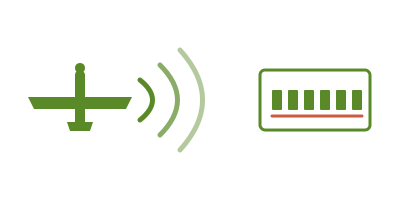
Every aircraft flying in United States airspace is legally required to broadcast a continuous radio signal. This signal — transmitted by the aircraft's Mode S transponder — contains a unique 24-bit identifier assigned by the FAA to that specific airframe. It cannot be turned off. It cannot be changed. It is, by design, permanently and uniquely tied to one aircraft.
What can be changed is what anyone looking up that identifier finds. And that is where the FAA's Limiting Aircraft Data Displayed (LADD) program comes in.
What LADD does
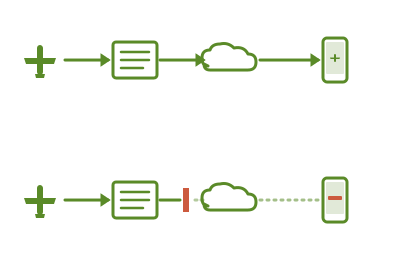
Under LADD, an aircraft operator can request that the FAA instruct public data aggregators — flight tracking services, ADS-B networks, aviation databases — to suppress the linkage between their aircraft's transponder code and its registration number. When you see an aircraft flying on a consumer tracking app and it shows as "N/A" or simply doesn't appear, that aircraft is likely enrolled in LADD.
The identifier is still being broadcast. The aircraft is still visible on radar. It is simply invisible to the public lookup.
The FAA created the program for legitimate reasons. Domestic violence survivors. Public figures with credible security threats. Individuals who use private aircraft for personal travel and have a reasonable interest in not having their movements tracked by anyone with a smartphone and an internet connection. These are real privacy interests, and the law generally recognizes them.
"A dream is just a dream. A goal is a dream with a plan and a deadline."
— Grace Hopper
Private citizens who happen to own aircraft are not accountable to the public for their movements in the same way that, say, a commercial airline is. Expecting that every flight of a personal aircraft be publicly logged and traceable would be analogous to requiring that every car emit a beacon announcing its location and owner. The burden of proof for that kind of transparency is high, and appropriately so.
Commercial enterprises are different
A flight school is not a private citizen flying to visit family. It is a business. Its aircraft are its product. Each flight it conducts is a commercial transaction that generates profit for the operator — and generates externalities for the surrounding community.
Externalities are costs that are not borne by the party creating them. When a flight school operates training circuits over a residential neighborhood, the noise, the lead emissions from avgas combustion, and the disruption to quality of life are not costs that appear on the flight school's balance sheet. They are borne by the residents below. This is not a moral judgment — it is an economic description of what happens.
The procedural mechanism by which communities manage externalities like this is the noise complaint. A resident identifies an aircraft causing harm, ties that aircraft to an operator, documents the event, and files a formal grievance with the relevant authority — the FAA, the local airport authority, the town planning board. Over time, a pattern of documented complaints creates the evidentiary record that regulatory and legal processes require.
This mechanism has a structural dependency: identification. The chain runs from aircraft to registration number to registered owner to accountable entity. Remove any link and the chain fails.

When LADD breaks the chain
When a commercial flight school enrolls its entire operating fleet in LADD, it removes the identification link for every aircraft it operates. A resident hears a plane, opens a tracking app, and finds nothing — or finds an aircraft with no registration attached. The complaint cannot be meaningfully filed, because the aircraft cannot be meaningfully identified through the channels that complaint systems are built around.
This is not a side effect of LADD. It is the function LADD performs, applied to a context it was not designed for. A privacy mechanism intended for individuals is being used by a commercial enterprise to insulate itself from the accountability mechanism for its externalities.
The harm is not abstract. If you cannot file a complaint because you cannot identify the aircraft, the regulatory record shows fewer complaints than the actual level of harm. Authorities looking at complaint data conclude that noise levels are tolerable. Flight operations continue unchallenged. The baseline gets worse.
What overfly does about it
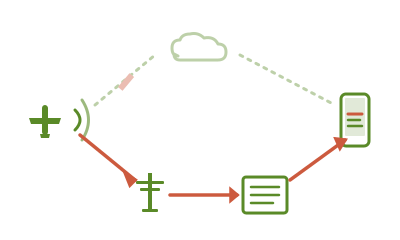
ADS-B transponders broadcast the 24-bit ICAO identifier regardless of LADD enrollment. A receiver physically present in the affected area captures that broadcast directly. overfly cross-references that identifier against the FAA aircraft registry — which contains the LADD enrollees, because LADD suppresses public display, not the registry itself.
When overfly resolves a LADD aircraft's identity, it records two things: the registration number, and the fact that the operator had enrolled in LADD. The combination is significant. It documents not just that the flight occurred, but that the operator had taken deliberate steps to prevent that flight from being documented through normal channels.
In the context of a commercial enterprise generating externalities borne by a residential community, this constitutes a documented attempt to evade the accountability mechanism by which those externalities would otherwise be resolved.
The program exists. Its legitimate uses are real. Its abuse by commercial operators is also real — and now documentable.
Sources
- FAA LADD Program: faa.gov/pilots/ladd/
- FAA Aircraft Registry, Releasable Aircraft Database: registry.faa.gov
- 14 C.F.R. Part 91 — General Operating and Flight Rules (transponder requirements)
- ADS-B Out requirements: 14 C.F.R. § 91.225