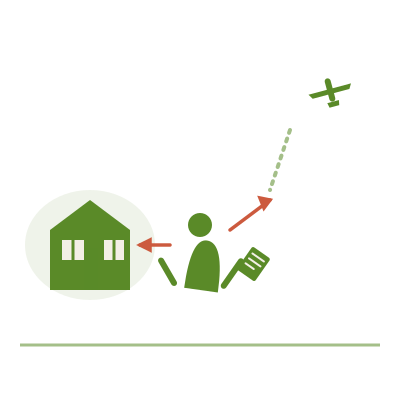
If you live near a flight school and you're tired of the noise, you've probably already noticed something frustrating: filing a complaint doesn't seem to do much. The flights continue. The noise accumulates. You file another complaint, and another, and nothing changes.
This is not because nobody is listening. It is because the problem has a structure that makes individual complaints systematically insufficient — and that structure has a name. Actually, it has two names, and they are mirrors of each other.
The tragedy of the commons
In 1968, biologist Garrett Hardin published an essay in the journal Science that described a pattern he called "the tragedy of the commons." The scenario: a shared pasture, open to all local farmers. Each farmer has a rational incentive to add more cattle, because they receive the full benefit of each additional animal while the cost — overgrazing — is distributed across all users. Every farmer, acting rationally in their own interest, grazes more. Eventually the pasture is destroyed.
No individual farmer did anything wrong by their own logic. The tragedy is structural, not moral.
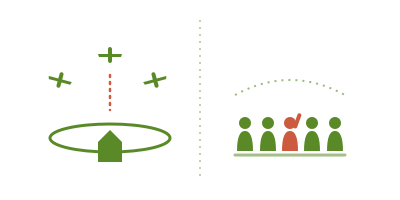
The commons
The airspace above a residential neighborhood. Shared by all, owned by none — a public resource whose use generates private profit and public cost.
The overgrazing
Each additional training flight benefits the flight school (revenue) and imposes costs on residents (noise, lead exposure, disruption) that never appear on the school's balance sheet.
The airspace above your neighborhood is a commons in exactly this sense. A flight school that operates training circuits over residential areas extracts value from that commons — the ability to run an efficient training operation — while distributing the costs to everyone below. The noise is real. The lead emissions are real. Neither shows up in the school's cost of doing business.
Economists call this an externality: a cost borne by parties who are not involved in the transaction that created it. Each training flight is a transaction between the school and its student. The residents are not parties. They bear the cost anyway.
Unmanaged externalities grow. The flight school has every incentive to expand operations. It has no mechanism that connects its profit to its impact on the neighborhood. Without external constraint, the commons degrades.
The collective action problem
Hardin's commons explains why the problem grows. But it doesn't fully explain why it's so hard for residents to stop it. For that, we need a second concept, developed by economist Mancur Olson in his 1965 book The Logic of Collective Action.
Olson observed something counterintuitive: large groups with shared interests are often worse at pursuing those interests than small groups — even when the large group has more aggregate power. The reason is the free-rider problem.
If you file a noise complaint, the cost is yours: the time to document it, the effort to find the right authority, the follow-up required to make it count. But the benefit — reduced flights, regulatory attention, changed policy — is shared by everyone in the neighborhood, including people who never filed anything. The rational individual choice is to let someone else do it and benefit from their effort.
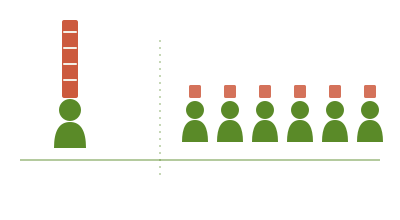
Few complaints does not mean few people affected. It means the cost of complaining exceeds the individual benefit of complaining, even when the collective benefit would be substantial. The silence of residents is not consent — it is a rational response to a structural incentive.
Flight schools know this, whether explicitly or intuitively. Complaint systems that are time-consuming, confusing, or require specific aircraft identification information (which LADD suppresses — see our post on the LADD program) all raise the individual cost of complaining. Fewer complaints reach the authorities. The record looks quieter than the neighborhood is.
Two mirror problems, one dynamic
The tragedy of the commons and the collective action problem are structural counterparts. The commons explains why operators overuse shared resources: costs are externalized. The collective action problem explains why residents underreport: the benefit of individual action is distributed while the cost is concentrated.
Together, they create a dynamic where the noise keeps getting worse and the official record shows that it isn't. Regulatory bodies look at complaint counts and see a manageable situation. The manageable situation is an artifact of the collective action problem, not a reflection of actual conditions.
This dynamic is not unique to aviation noise. It appears wherever a diffuse public bears costs generated by a concentrated private interest. Pollution, housing density, traffic — the structural logic is the same. What makes aviation noise distinctive is the combination of factors that make it particularly hard to address: federal preemption of local regulation (more on that in our post on ANCA), technical barriers to aircraft identification, and the LADD program's ability to eliminate that identification entirely.
The hidden cost: you must stop escaping to document
Olson's model captures most of the collective action problem. But there is a cost it doesn't account for, and it may be the most important one.
The rational response to aircraft noise is avoidance. Close the windows. Put on headphones. Move your desk away from the garden. Go inside. Accept the loss and stop attending to the source. This is adaptive behavior — the mind's mechanism for managing an exposure it cannot eliminate.
Filing a noise complaint requires the opposite. You must hear the aircraft. You must identify it. You must timestamp it. You must research where to file. You must submit, and wait, without knowing whether the submission will be acknowledged, whether the record will be used, whether anything will change. To do this, you must deliberately expose yourself to the harm you are trying to escape. You must lean into what your instincts tell you to avoid.
This is the asymmetric cost that is missing from standard accounts of the collective action problem. It is not just that the individual benefit of complaining is small relative to the effort. It is that the act of complaining requires sustained attention on something the complainant is simultaneously trying to psychologically distance themselves from. Every documentation effort is a choice to remain in contact with the source of harm, rather than retreat from it.
And then: no feedback. You file. You don't know if anyone read it. You don't know if it was counted. You don't know if it will contribute to anything. You invest attention and energy into a process you have no reason to trust — and the next morning the planes are there again.
This is what is absolutely dramatic about the tragedy of the commons as it applies here. People are fighting their drive to remove themselves from exposure while simultaneously being asked to lean into it. To fight the noise, you must first listen to it. The complaint system is not designed for humans as they actually respond to harm.
What changes the calculus
Elinor Ostrom won the Nobel Prize in Economics in 2009 for demonstrating something Hardin had missed: commons can be governed without destruction, but only when communities develop mechanisms for monitoring, enforcement, and collective decision-making. The commons doesn't have to be tragic. It requires investment in the infrastructure of accountability.
The collective action problem has a parallel solution: lower the individual cost of contributing to the collective good, and aggregate individual contributions so they produce evidence that no single contributor could generate alone.
The psychological cost has a parallel solution too: separate the act of exposure from the act of documentation. If you only have to tap once — and the system handles identification, timestamping, attribution, and record-keeping — then you are not required to sustain attention on the harm. You acknowledge it in the moment, and you move on. The documentation happens without the extended re-exposure.
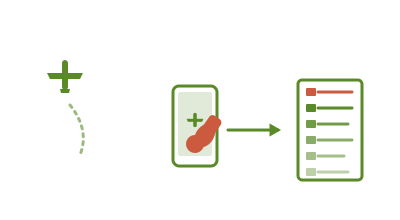
This is what overfly is built to do. One tap per aircraft. No manual identification. No research required to find the right complaint form. Each tap costs seconds. The record it builds — timestamped, attributed, aggregated across every resident who participates — costs the flight school something it cannot currently avoid paying: a documented pattern, visible to regulators, that cannot be dismissed as anecdote.
The tragedy of the commons is not inevitable. It is the default outcome when accountability infrastructure is absent and when the cost of resistance is higher than the cost of tolerance. Building that infrastructure — and lowering that cost — is civic work. overfly is one piece of it.
Sources
- Hardin, G. (1968). "The Tragedy of the Commons." Science, 162(3859), 1243–1248.
- Olson, M. (1965). The Logic of Collective Action: Public Goods and the Theory of Groups. Harvard University Press.
- Ostrom, E. (1990). Governing the Commons: The Evolution of Institutions for Collective Action. Cambridge University Press.
- Coase, R.H. (1960). "The Problem of Social Cost." Journal of Law and Economics, 3, 1–44. (On externalities and transaction costs.)